

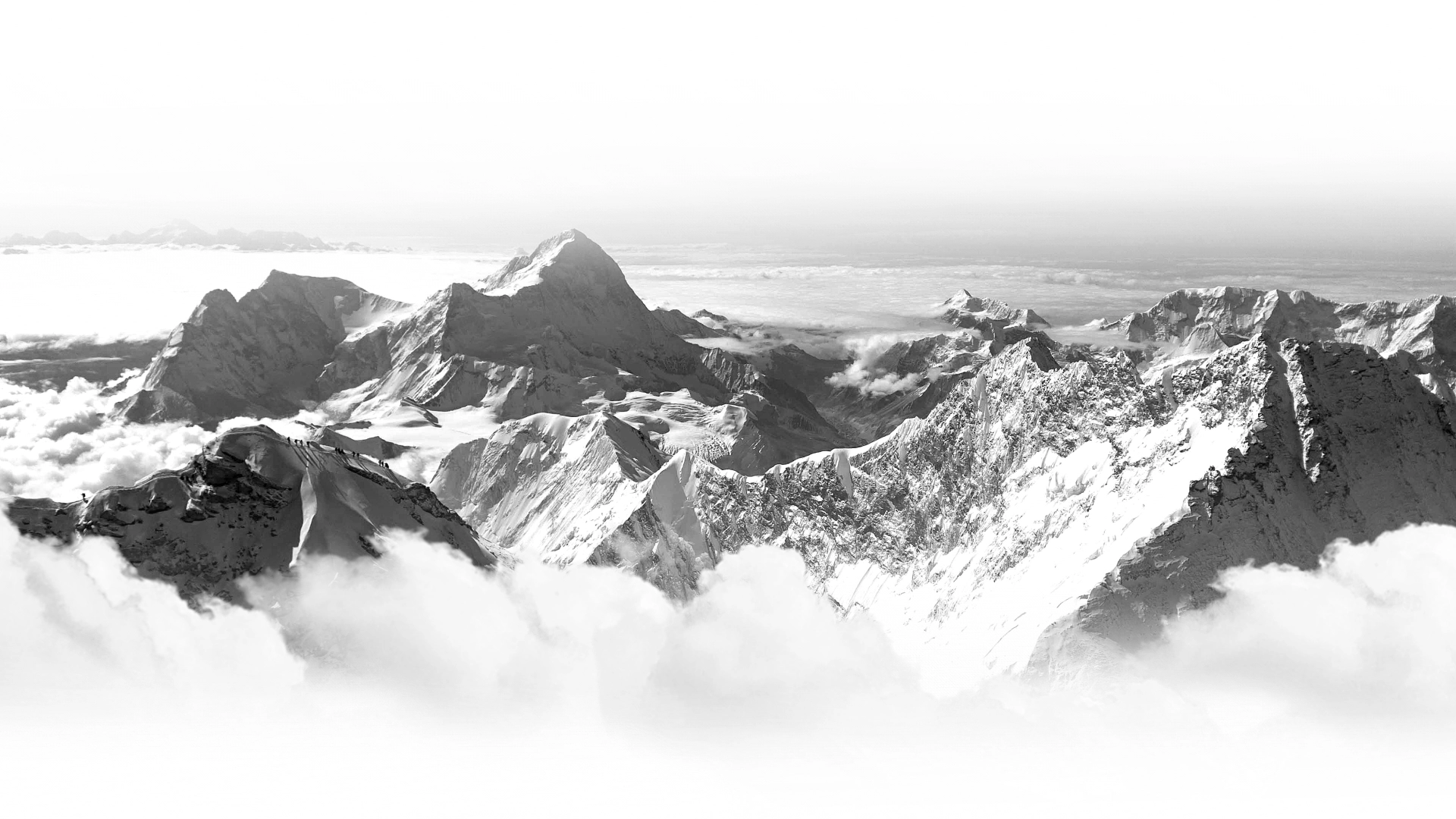
LHOTSE EXPEDITION
Trip Description
Lhotse — meaning 'South Peak' in Tibetan was first summited on 18 May 1956 by Ernst Reiss and Fritz Luchsinger of Switzerland via the South Col route, three years after Everest's first ascent. It occupies the same massif as Everest, connected by the South Col at 7,906m and sharing a common approach from the Nepal side. Its summit is the fourth highest point on Earth, below only Everest, K2, and Kangchenjunga — yet it receives a fraction of the expedition activity of any of the three above it.
The mountain has three distinct summits: the main summit at 8,516m, Lhotse Shar at 8,383m, and Lhotse Middle at 8,414m. The main summit via the South Col route is what this expedition targets. The route follows the Everest South Col line through the Khumbu Icefall and Western Cwm before ascending the Lhotse Face — a steep blue-ice slope that sits directly below Camp 3 at 7,200m. This section is shared with Everest climbers, but above Camp 3 the routes separate. Lhotse continues directly up the face toward the Couloir rather than traversing left toward the South Col.
The Lhotse Couloir is the mountain's defining feature. From approximately 7,800m, the route enters a compressed ice gully that rises at a sustained steep angle to the summit. The ice in this section is often hard and blue, requiring precise crampon technique and confident movement on fixed ropes in terrain that offers very little margin for error. Wind is channelled and concentrated through the Couloir, and the exposure increases sharply as altitude is gained. Above 8,000m in this terrain, the demands are unlike those of any other section of the South Col route — and significantly different from the open, ridge-following approach to Everest's summit above the South Col.
Lhotse holds a specific respect among high-altitude climbers that is not always reflected in its public profile. The Couloir has turned back more experienced 8,000-metre climbers than most other technical sections in the range. It is a mountain that rewards exactly the kind of preparation — technical competence at altitude, disciplined acclimatization, and the judgment to manage steep ground above 8,000m — that a serious expedition company and IFMGA guiding can provide.


Trip Overview
Lhotse stands at 8,516 metres — the fourth highest mountain in the world, immediately south of Everest and sharing its western flank with the most famous mountain on Earth. Despite that proximity, Lhotse draws a fraction of Everest's annual expedition traffic. That is partly because it sits in Everest's shadow, and partly because the upper mountain is genuinely harder. The Lhotse Couloir — the near-vertical ice gully that defines the final 600 metres to the summit — is one of the most demanding sections on any 8,000-metre peak. Climbers who have done both consistently describe Lhotse's technical difficulty above 8,000 metres as greater than Everest's.
The approach follows the same route as Everest: the Khumbu trek from Lukla through Namche Bazaar, Tengboche, and Pheriche to Base Camp at 5,364m. The two mountains share the same Base Camp. The Khumbu Icefall, Camp 1, Camp 2 in the Western Cwm, and the Lhotse Face are all identical to the Everest South Col route. The routes diverge at Camp 3 — Everest continues left toward the South Col, while Lhotse branches right and into the Couloir, a steep and sustained ice gully that narrows as it gains altitude and demands technical competence at 8,000m that has no equivalent on the standard Everest route.
This makes Lhotse an unusual 8,000-metre objective. The approach is well-known, the Icefall is familiar to many, and the infrastructure is established. But the summit itself is a different level of technical demand, a mountain that requires genuine alpine skill in the final section, not just altitude conditioning and physical endurance. Climbers who have already been on the South Col route have a real advantage on the approach. Those who want a true technical 8,000m challenge without the logistics and crowds of an Everest expedition have their answer in Lhotse.
Spring is the only recommended season. The Lhotse Couloir is significantly more dangerous and less climbable in autumn, and the post-monsoon window does not provide the consistent conditions the upper route requires. Spring's pre-monsoon weather pattern, the same window that governs Everest — delivers the most reliable summit days on Lhotse.
Expedition Highlights
-
Summit Lhotse (8,516m) — the world's fourth highest mountain and one of the most technically demanding 8,000m peaks
-
The Lhotse Couloir — a near-vertical ice gully above 8,000m that requires genuine technical alpine competence. The defining challenge of the mountain
-
Shared approach with Everest — the Khumbu trek, Base Camp, and Icefall are familiar ground, while the Lhotse route offers its own distinct summit challenge
-
Far less crowded than Everest — a serious expedition to a more serious mountain in a quieter environment
-
Unlimited supplemental oxygen for all members and guides throughout the high-altitude phase
-
1:1 Climbing Sherpa support on summit day — every member personally accompanied
-
Government liaison officer included
-
IFMGA-certified lead guide with personal Lhotse summit experience
-
Option for a fully private 1:1 expedition with IFMGA Guide Mr. Prakash Sherpa
Led by IFMGA-Certified Professionals
Lhotse's upper route demands more of a guide than the standard Everest South Col approach. Managing a rope team through the Lhotse Couloir on hard ice at 8,000m, in cold and often windy conditions, with the summit still several hundred metres above requires a guide who has been in that specific terrain before and whose technical and altitude experience is genuinely equal to the demands of that section.
Every Lhotse expedition organized by Alpinist Climber Expeditions is led by an IFMGA / UIAGM / IVBV-certified mountain guide — the highest internationally recognized certification in professional mountain guiding. Our lead guides hold additional qualifications in Advanced Mountaineering, Wilderness First Aid, Helicopter Rescue and Marshalling, and High-Altitude Rescue, all directly applicable to the terrain encountered above Camp 3 on Lhotse.
Mr. Prakash Sherpa, CEO and Lead IFMGA Mountain Guide of Alpinist Climber Expeditions, has personally summited Lhotse alongside Everest (five times), K2, Makalu, Cho Oyu, Dhaulagiri, Manaslu, Nuptse, Pumori, and many more — several without supplemental oxygen. He has been guiding professionally since the age of 15 with over 15 years of high-altitude experience. He is a member of the Nepal National Mountain Guide Association (NNMGA). For those selecting the premium 1:1 private option, Mr. Prakash Sherpa leads the Lhotse expedition personally.
Detailed Itinerary

A representative from Alpinist Climber Expeditions meets you at Tribhuvan International Airport and transfers you to your 4-star hotel. The evening opens with a welcome dinner — the full expedition team gathers, and your lead guide introduces the route, the team, and the 35 days ahead.
1,330m
Hotel

A comprehensive briefing covers the full route — the Khumbu trek, the Icefall, the Lhotse Face, and the specific demands of the Couloir above Camp 3. Safety protocols, oxygen system management, acclimatization plan, and permit formalities are all covered. Equipment is checked and confirmed. You receive your Alpinist Climber Expeditions duffel bag, cap, and T-shirt. The afternoon is a guided tour of Kathmandu's UNESCO World Heritage Sites.
1,330m
Hotel

An early mountain flight from Kathmandu to Lukla (2,840m) in approximately 35 minutes. The team assembles, loads are organized, and the trek begins along the Dudh Koshi River through pine forest to Phakding. The first day on the trail — familiar ground for many, and one of the finest valley treks in Nepal regardless.
2,610m
Lodge

The trail crosses the Sagarmatha National Park checkpoint at Monjo and climbs steeply to Namche Bazaar at 3,440m. The altitude gain is significant and the final two hours to Namche are demanding. The first views of Everest — and of Lhotse's south face rising immediately right of Everest's Southwest Face — appear above the ridge on the final approach. Lhotse's scale from this angle is striking.
3,440m
Lodge

A structured acclimatization day. A morning hike to the Everest View Hotel ridge at 3,800m follows the principle of climbing high and sleeping low. From this ridge, Lhotse's south face is fully visible — a massive wall of rock and ice that rises unbroken from the Khumbu Glacier to the summit at 8,516m. The objective for the next month is directly in view. The afternoon is free in Namche.
3,440m
Lodge

The trail descends through rhododendron forest before climbing to Tengboche and its famous monastery. Ama Dablam and Lhotse dominate the view from the monastery ridge. The monastery is one of the most significant Buddhist sites in the Khumbu and worth time before continuing to the overnight lodge.
3,860m
Lodge

The route passes through Pangboche before climbing to Pheriche at 4,371m. The upper Khumbu opens up here and the altitude is felt clearly. Lhotse's south wall is now very close — the mountain fills the upper valley ahead with a presence that sharpens focus on the weeks to come. Proper hydration and a steady pace are the priorities.
4,371m
Lodge

A mandatory acclimatization hike to the top of Nangkartshang at 5,083m above Pheriche. The two to three hour climb delivers the team's first sustained effort above 5,000m and a panoramic view of the Khumbu, Makalu, and the full south wall of Lhotse at close range. The descent returns to Pheriche for the night. This hike is one of the most important altitude adaptation steps in the approach.
5,083m
Lodge

The trail climbs through Dughla past the memorial chortens at Thokla — a sobering and meaningful pause that marks the passing of many climbers and Sherpas who have been on these mountains. Above Thokla, the terrain opens onto the high plateau below Lobuche. Lhotse's northwest face is now visible above the Khumbu Glacier, and the Icefall — the first obstacle of the climb — can be seen at the foot of the mountain.
4,940m
Lodge

A shorter but demanding walk to Gorak Shep at 5,160m — the last lodge stop before Base Camp. The trail crosses the lateral moraine of the Khumbu Glacier and the effects of altitude are pronounced. Kala Patthar rises above the village. Base Camp is less than two hours ahead. The team rests early in preparation for the arrival at Base Camp the following morning.
5,160m
Lodge

The final approach to Base Camp crosses glacial moraine on the Khumbu Glacier — rocky, undulating terrain with ice visible on both sides. The Khumbu Icefall rises directly above as Base Camp comes into view. Our Base Camp is equipped with private dome tents per member, hot showers on request, and a well-equipped dining area. The Lhotse Face rises in full scale to the east of the Icefall. The route above is visible from the tent door.
5,364m
Camp

The Puja ceremony is conducted at Base Camp — a traditional Sherpa blessing led by a lama, attended by every member of the team and all support staff. All climbing equipment is blessed before use on the mountain. At a Base Camp shared with Everest teams, the Lhotse expedition's Puja carries its own distinct focus — the Couloir above is a different objective, and the ceremony reflects that. The day is otherwise dedicated to rest and equipment organization.
5,364m
Camp

This 17-day window is managed entirely in the field by the expedition leader. The daily sequence is determined by weather, route conditions on the Lhotse Face and in the Couloir, and team readiness — it cannot be pre-scripted.
The typical structure: technical training at Base Camp covering Icefall navigation, Couloir-specific ice technique, and oxygen system use → first rotation to Camp 1 (6,065m) at the top of the Icefall and return to Base Camp → second rotation to Camp 2 (6,400m) in the Western Cwm and return → rest at Base Camp and lower villages for recovery → third rotation reaching Camp 3 (7,200m) on the Lhotse Face → recovery at Base Camp → summit push: Camp 1 → Camp 2 → Camp 3 → Camp 4 (7,800m) at the base of the Couloir → summit day through the Lhotse Couloir to 8,516m → descent to Camp 2 and Base Camp.
Summit day from Camp 4 begins in the early hours — typically 10 PM to 1 AM. The Couloir is approached in darkness, with the team moving on fixed rope through increasingly steep and hard ice as altitude is gained. The summit of Lhotse at 8,516m is a narrow, exposed point on the ridge. The descent back through the Couloir requires the same technical attention as the ascent. Unlimited supplemental oxygen is in use above Camp 2 for all members and guides throughout this window.
8,561m
Camp

Base Camp is cleaned and broken down. All tents are struck, equipment packed, and the site left clean per Sagarmatha National Park standards. The team descends to Lobuche — the first lodge night since arriving at Base Camp 19 days earlier. The altitude drop from 5,364m to 4,940m provides immediate physical relief.
4,940m
Lodge

The return trek moves south through the upper Khumbu. The descent through Dughla and past Thokla toward Pangboche is a well-worn trail seen from the other side of the summit. Lhotse's south wall recedes behind as the valley widens below. Pangboche's ancient monastery is a fitting final cultural pause before the lower valley.
3,985m
Lodge

The route continues through Tengboche and back to Namche. The descent through rhododendron forest is pleasant and the lower altitude immediately noticeable. Namche is a comfortable night before the last trekking day to Lukla.
3,440m
Lodge

The final trekking day follows the Dudh Koshi downstream through Phakding to Lukla. A well-known trail, walked now with the weight of the expedition behind it. Porters are thanked and farewelled. The last night on the trail.
2,860m
Lodge

An early flight from Lukla returns the team to Kathmandu. The afternoon is free. A farewell dinner in the evening is the formal celebration of one of the most serious and technically demanding expeditions in Nepal — the fourth highest mountain on Earth, the Lhotse Couloir, and everything it took to reach it.
1,330m
Hotel

Private airport transfer for your outbound flight. The Lhotse Expedition concludes — 35 days from Kathmandu to the world's fourth highest summit and back.
Why ACE?
Alpinist Climber Expeditions was built around a principle that has guided every climb we have organized — that the quality of the experience on a mountain is directly tied to the quality and depth of experience of the people leading it. What sets Alpinist Climber Expeditions apart is something that cannot be manufactured or replicated — it comes from decades spent on these mountains, from the culture that formed us, and from a deeply held belief that every climb deserves to be done properly.
We are a team of professional Sherpas. Not guides who have visited the Himalaya — guides who grew up here, who know these peaks in every season, and who have spent careers developing the technical skills and mountain judgment required to lead expeditions safely and successfully.
Our team holds IFMGA / UIAGM certification — the highest international standard in professional mountain guiding — alongside Advanced Mountaineering, Wilderness First Aid, Helicopter Rescue, and High-Altitude Rescue qualifications. Our lead guide has summited multiple 8,000-metre peaks, including ascents without supplemental oxygen. This is not a credential on paper. It is a lived capability that directly protects every climber who climbs with us.
We offer two expedition structures: a standard option with small-group expedition, and a premium option with 1:1 guide-to-client ratio. Both are built on the same standard of safety, preparation, and professionalism.The standard option maintains a minimum 1:3 guide-to-client ratio with a dedicated IFMGA lead guide and Sherpa support on every climb. Our premium 1:1 private option places you on the mountain directly alongside IFMGA Guide Mr. Prakash Sherpa.
We do not run high-volume operations as our clients are not bookings. They are climbers who have chosen to trust us with something significant and we take that trust seriously on every single expedition. We do not cut corners on acclimatization, staffing ratios, or safety equipment. We organize expeditions the way they should be organized — with patience, precision, and the kind of local knowledge that only comes from growing up in these mountains and spending a career on them.
The Team
Expedition Guides
Every guide on our team has been selected for their technical ability, high-altitude experience, and personal commitment to the safety and success of every climber they lead. All guides carry extensive experience at altitude and hold a proven record of safety, summit success, and strong compatibility with international clients.
The number of guides assigned to each expedition is determined by the size of the climbing team. Our standard guide-to-member ratio is 1:3, ensuring that every climber receives consistent, attentive support throughout the approach, the acclimatization phase, and the technical climb itself.
Climbing Sherpa Support
A dedicated team of experienced Climbing Sherpas supports every expedition with load carrying on the mountain, route preparation, and high camp management. On summit day, we maintain a 1:1 Sherpa-to-climber ratio — a commitment that reflects our belief that the summit push is where support matters most.
Our Climbing Sherpas are not simply load carriers. They are experienced high-altitude professionals who understand the mountain, the route, and the demands of summit day. Their presence alongside every climber on the final push is a core part of how we manage safety and success on the upper mountain.
What to Expect from Our Team
- Technically qualified, IFMGA-certified lead guidance on every expedition
- A standard guide-to-member ratio of 1:3 — adjusted based on team size and peak requirements
- 1:1 Climbing Sherpa support on summit day for every team member
- Guides who are experienced, companionable, and genuinely invested in your success
- Full medical kit, satellite communication, and emergency response capability carried by the team at all times
- A premium 1:1 private option available — summit alongside Mr. Prakash Sherpa directly
Trip Notes
-
Spring (March to May) is the only recommended season for Lhotse. The pre-monsoon weather window delivers the most stable conditions on the Lhotse Face and in the Couloir. Autumn expeditions on Lhotse are extremely rare and the conditions in the Couloir are significantly more challenging post-monsoon. This expedition does not operate in autumn or winter.
-
The expedition runs for 35 days from arrival in Kathmandu to final departure. The Khumbu approach takes nine days from Lukla. The climbing period spans approximately 17 days.
-
Lhotse and Everest share a Base Camp. Members on this expedition share the Base Camp environment with Everest teams during spring season. This is standard and well-managed — the camps are distinct, the logistics are separate, and the route above Camp 3 diverges completely.
-
Group size is a minimum of 2 members with 1 IFMGA Mountain Guide, and a maximum of 6 members with 2 IFMGA Mountain Guides. The number of guides is determined by team size.
-
Prior experience above 7,000 metres is strongly recommended. Experience on a technical 7,000m peak such as Baruntse or Nuptse, or a prior 8,000m expedition such as Cho Oyu, provides the most relevant preparation for the Lhotse Couloir. Candidates without prior high-altitude technical experience above 7,000m should speak with us before applying.
-
A free duffel bag, cap, and T-shirt are provided at the team meeting in Kathmandu. Non-expedition luggage can be stored at your hotel in Kathmandu.
-
Personal travel insurance with high-altitude rescue and medical evacuation coverage is mandatory. Your policy must cover mountaineering at 8,516m and include helicopter rescue. This must be confirmed before departure for Nepal.
Equipments
Lhotse's upper route involves hard blue ice in the Couloir at altitudes above 8,000m. Every item of personal equipment must be rated for extreme cold and tested in the field before departure. The quality requirements are identical to Everest — the technical demands are, in some sections, greater.
Clothing
-
Expedition down suit — highest grade available (Rab, Mountain Hardwear, or equivalent)
-
Expedition down jacket — best available brand
-
Waterproof Gore-Tex jacket and over-trousers fitting over alpine boots
-
Balaclava fully covering nose and face — BUFF or equivalent
-
Long sleeve thermal shirt and trousers — moisture-wicking base layer
-
Fleece jacket and fleece trousers
Handwear & Footwear
-
Thin liner gloves — warm and close-fitting
-
Down mitts — required above Camp 3
-
Gore-Tex Primaloft insulated gloves
-
Mountain gloves — waterproof and windproof
-
Smartwool mountaineering socks (2 pairs — new)
-
Ultra-soft running or hiking socks (2 pairs — new)
-
High-altitude mountaineering boots — La Sportiva G2 Evo or equivalent
-
Alpine boots for lower camp and lodge use — La Sportiva or Scarpa equivalent
Technical Climbing Equipment
-
UIAA-tested climbing helmet — Petzl or BD
-
Sit harness — Petzl or BD
-
Ski goggles with UV protection and anti-fog system
-
UV-protective sunglasses
-
Headlamp with spare Energizer Ultimate Lithium batteries
-
Ascender (jumar) — Petzl or BD
-
Abseiling device (ATC guide) — Petzl or BD
-
Screw gate carabiners — 2 large, 2 small
-
Bent gate carabiners — 2 medium
-
6mm cord — 2m and 5m (UIAA tested)
-
Dynamic 8mm rope — 2m (UIAA tested)
-
Ice axe — classic alpine type (Petzl, Grivel, or BD)
-
Crampons compatible with high-altitude boots (Grivel, Petzl, or BD)
General Equipment
-
Sleeping bag rated to -20°C or colder
-
45–75 litre rucksack
-
Large duffel bag with padlock
-
1-litre water bottles (x2) and 1-litre stainless steel thermos
-
Personal first aid kit and trekking poles
-
Swiss army knife or Leatherman multi-tool
Upcoming Departure Dates
May 18
-
14 June, 2026
Available
July 24
-
2 December, 2027
Available
Whats Included
-
 Lhotse climbing royalty fees
-
Sagarmatha National Park entry permit and TIMS card
-
Summit route fixing and SPCC fees
-
Government liaison officer — wages, insurance, and transportation
-
Garbage disposal and environmental management fees
-
All government taxes, VAT, and official tourism service charges
-
IFMGA-certified lead mountain guide — full wages and comprehensive insurance
-
Experienced Climbing Sherpa support — 1:1 ratio on summit day — wages, summit bonus, equipment, and full insurance
-
Base Camp cook and kitchen support — wages, insurance, and equipment allowance
-
Porters to carry trekking and expedition gear at a 1:1 member-to-porter ratio
-
All staff accommodation, wages, equipment, insurance, and medical provisions
-
4-star hotel accommodation in Kathmandu with daily breakfast (4 nights)
-
Full-board lodge accommodation during the trek approach and return
-
Single dome tent per member at Base Camp with hot shower
-
High camp tents at Camp 1, Camp 2, Camp 3, and Camp 4
-
Domestic flights: Kathmandu to Lukla and return (both ways)
-
Private vehicle airport transfers in Kathmandu
-
Unlimited supplemental oxygen for all members and guides
-
Oxygen mask and regulator per member and guide
-
Welcome dinner on Day 01 and farewell dinner on Day 34 in Kathmandu
-
Full-board meals during the trek approach, Base Camp, and high camps
-
High-altitude food and provisions for members and guides at all high camps
-
Medical kit carried throughout the expedition
-
Satellite phone for emergency communication
-
Walkie-talkie radios for team coordination on the mountain
-
Alpinist Climber Expeditions branded duffel bag, cap, and T-shirt per member
Whats Not Included
-
 International airfare (to and from Kathmandu)
-
Nepal entry visa fees
-
Lunch and Dinner in Kathmandu
-
Alcoholic beverages and internet / WiFi access
-
Personal clothing and climbing equipment
-
Special drone permit fees
-
Climbing Sherpa summit bonus
-
Personal travel, medical, and emergency rescue insurance
-
Gratuities for guides, Climbing Sherpa, and all staff
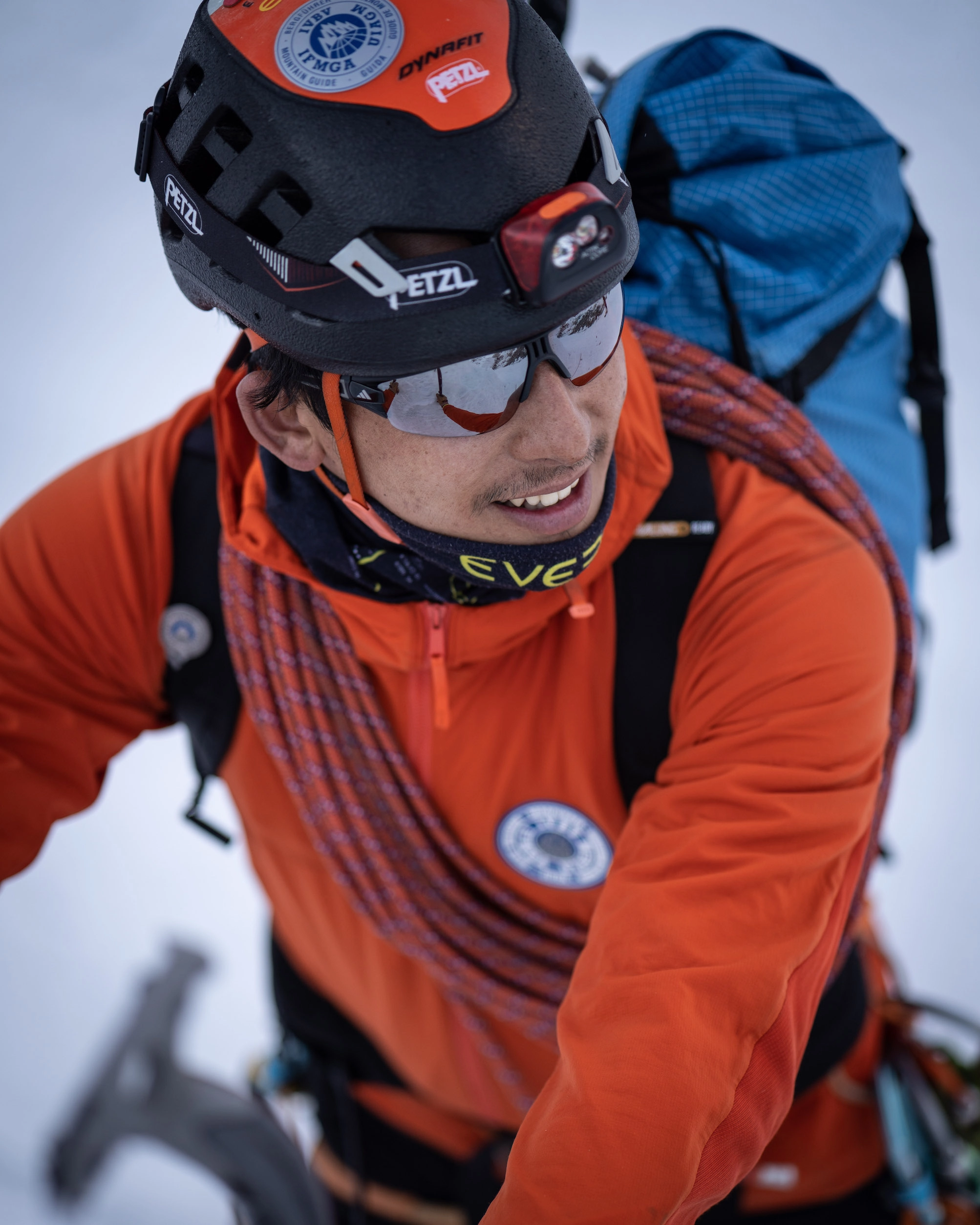
Get the 1:1 Guide Experience.
Our IFMGA certified guide - Prakash Sherpa oversees all our expeditions and operations, but you can also guarantee that he'll be your personal, 1:1 guide on the mountain.
FAQs
Personalize Your Trip
Enquiry Now →
Flexible options are available to adjust the itinerary, services, and guiding support based on your needs.